Broker Check
Understanding The Purpose Of Life Insurance In Retirement

Understanding The Purpose Of Life Insurance In Retirement

How Retirement Reshapes The Role Of Life Insurance

For many families, the purpose of life insurance is straightforward in the early years: protect a paycheck, keep the household running, and make sure dependents can stay on track if something happens. Near retirement, the math changes. Income may be less dependent on wages, but new needs can appear that still call for dependable liquidity.
As mortgages shrink and children become financially independent, the “income replacement” reason for coverage often fades. In its place, retirees may use life insurance to create cash on demand at death, support a surviving spouse’s financial stability, equalize an estate among heirs, or make a meaningful charitable gift. The shift is subtle but important, because it moves the conversation from “How much coverage is enough?” to “What role do we need this policy to play now?”

Key Takeaways

Retirement planning tends to expose gaps that are easy to miss while you are still accumulating assets. Life insurance can sometimes fill those gaps, but only when the policy structure matches the job you need it to do.

  • The purpose of life insurance near retirement often shifts from income replacement to liquidity, legacy, and planning flexibility.
  • Policy type matters: term, whole life, and universal life solve different problems and come with different trade-offs.
  • Ownership and tax rules can change outcomes, especially for estate planning and older policies.
  • Regular reviews help confirm your policy still aligns with your current goals, family structure, and funding plan.

If you think of life insurance as a “set it and forget it” product, retirement is usually the moment that assumption gets tested. A practical review can clarify whether your coverage still fits, or whether it needs to be adjusted to match today’s priorities.

Turning Coverage Into A Retirement Planning Asset

At its core, the purpose of life insurance is simple: convert premium payments into a guaranteed pool of liquidity that arrives at a specific moment. For retirees, that timing can be the entire point. A death benefit can help pay final expenses, support a spouse, or provide cash so heirs are not forced to sell investments or property quickly.

In a retirement plan, life insurance can also function as a pressure valve. If markets are down, liquidity from a death benefit can reduce the likelihood that a family needs to make rushed financial decisions. For some households, coverage also supports planning goals like replacing a pension that stops at death, providing generally income-tax-free death benefit proceeds under federal rules, or creating leverage for charitable giving through a beneficiary designation.

If you are reassessing coverage as you near retirement, a policy review can help confirm whether your current contract still supports the purpose you expect it to serve.

Matching Policy Structure to Your Planning Priorities

Different policies support different parts of the purpose of life insurance. The right choice depends on whether you need coverage for a defined period, for a lifetime, or for a specific planning objective like estate liquidity.

Before comparing options, it helps to be clear on the “job” you are hiring the policy to do. Once that is defined, the differences between term and permanent coverage become much easier to evaluate.

How Common Policies Stack Up For Retirement Goals

The table below outlines how common policy types are typically used near retirement, along with practical considerations that often matter in real-world planning.
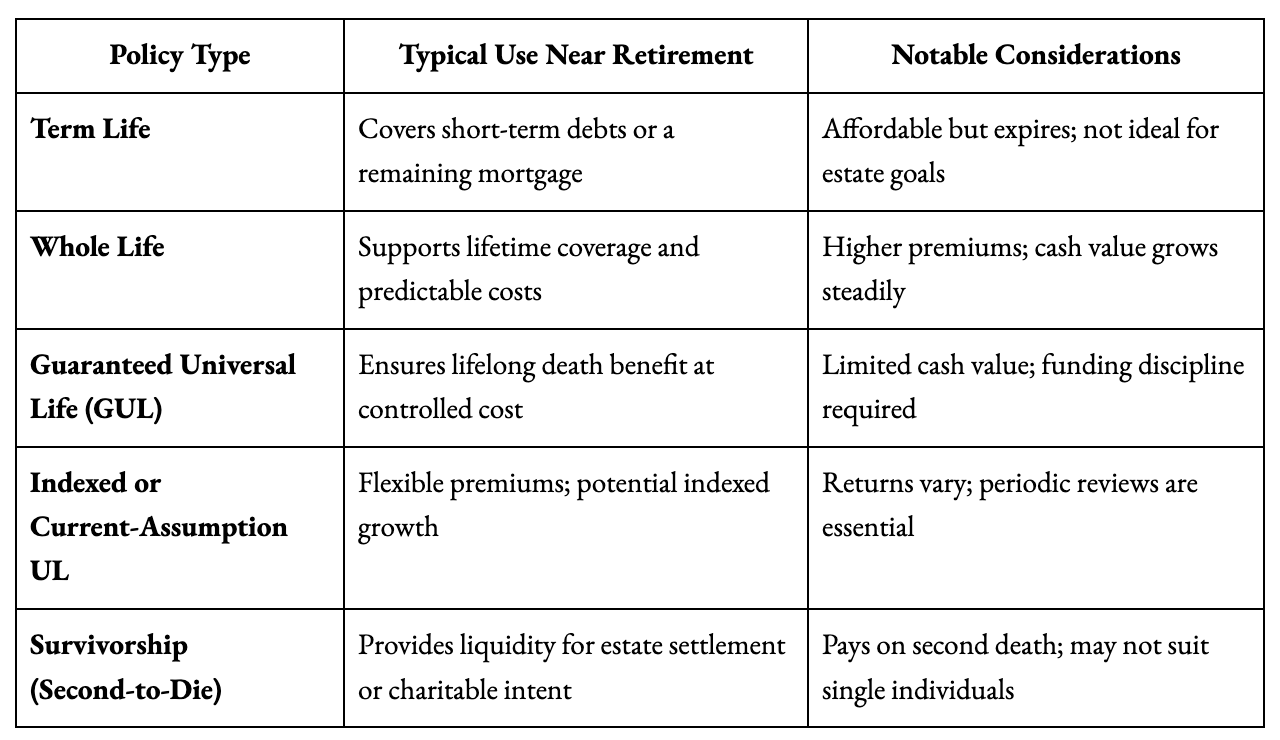
A common planning preference near retirement is to focus on policies that deliver a reliable death benefit without requiring unnecessary complexity. In many cases, GUL or carefully funded universal life can be positioned for lifetime protection when the primary goal is liquidity at death, rather than building significant cash value.

Picking Coverage Based on Your Retirement Reality

The purpose of life insurance becomes easier to see when you anchor it to a real planning scenario. Policy fit is rarely about “best policy on paper.” It is about the most appropriate tool for your household structure, assets, and goals.

Here are a few profiles that commonly show up in retirement planning:

  • Single with charitable goals: A modest permanent policy can create a meaningful gift through a nonprofit beneficiary designation without relying on market timing.
  • Married with a pension that ends at death: Coverage can help replace income for the surviving spouse when pension options reduce or stop after the first death.
  • Business owner nearing a sale: Life insurance may support transition planning, help fund agreements, or balance inheritances when a business is the primary asset.
  • High-net-worth household with real estate holdings: Survivorship coverage can provide liquidity that helps heirs avoid selling property under time pressure.
  • Couple concerned about long-term care costs: Some hybrid policies combine life insurance and long-term care features, which may increase flexibility depending on design.

When the purpose of life insurance is aligned to your situation, the policy becomes less about tradition and more about function. If your needs have changed since the coverage was purchased, that alignment is worth revisiting.

The Fine Print That Matters More Near Retirement

Many retirees assume a policy will behave the way it did on the day it was purchased. In practice, outcomes can hinge on details that sit outside the premium amount and death benefit. Tax rules, ownership structure, and policy design can all shape whether the policy fulfills the purpose you intend.

A few factors that commonly affect results include:

  • Ownership and estate inclusion: If you retain “incidents of ownership,” death proceeds may be included in your taxable estate. In some situations, an irrevocable life insurance trust (ILIT) is used to remove the policy from the estate, though suitability depends on your broader plan and legal guidance.
  • Modified Endowment Contract (MEC) status: Overfunding a policy can cause it to be classified as a MEC, which changes how withdrawals and loans are taxed. This is especially relevant if you were counting on cash value access later.
  • Transfer-for-Value rule: Selling or assigning a policy can reduce or eliminate the typical income-tax exclusion on death benefit proceeds, depending on the facts and exceptions that apply.
  • Policy performance risk: Interest-sensitive contracts may require monitoring. Assumptions that looked reasonable years ago can shift, particularly in prolonged low-rate environments or when charges increase.

Older policies can be especially important to review. Contracts issued decades ago may carry outdated assumptions, and the gap between illustrated and actual performance can widen over time. A review does not automatically mean a change is needed, but it can confirm whether the policy is still on track for the purpose you expect it to serve.

Aligning Coverage With Retirement Income and Legacy Goals

When life insurance is structured thoughtfully, it can support multiple planning priorities at once. For some retirees, the purpose of life insurance includes survivor income support, estate liquidity, and charitable intent, all while preserving investment flexibility.

The key is coordination. A policy that sits outside your broader plan can create confusion, while a policy that is integrated into your retirement income and estate strategy can be easier to manage and more likely to function as intended.

A Simple Process for Reviewing Coverage

Before you make changes, it helps to walk through a clear process. The steps below can help frame what to evaluate and why it matters.

  1. Clarify your intent. Decide what you want the purpose of life insurance to be today: income continuity, estate liquidity, legacy support, philanthropy, or a mix.
  2. Coordinate beneficiaries and ownership. Confirm the policy matches your current plan, especially after remarriage, family changes, or trust updates.
  3. Assess funding levels. Review whether premium design and projected values support coverage through your expected lifespan.
  4. Incorporate into your estate plan. Align policy details with wills, trusts, and other transfer strategies so the pieces work together.
  5. Review regularly. Interest rates, costs, and tax rules can shift, and periodic reviews help keep the policy aligned with its purpose.

If your coverage has not been reviewed in several years, it may still be valid, but it may not be optimized for the purpose you need now. A strategic review can help identify what is working, what is unnecessary, and what may need adjustment before major retirement decisions are made.

Frequently Asked Questions About The Purpose Of Life Insurance Near Retirement

Does The Purpose Of Life Insurance Change After The Mortgage Is Gone?
Often, yes. Once major debts are reduced and dependents are independent, the purpose of life insurance may shift toward estate liquidity, legacy planning, charitable giving, or supporting a surviving spouse’s financial structure.

What Policy Types Best Serve The Purpose Of Life Insurance For Legacy And Estate Planning?
Permanent coverage, such as whole life, guaranteed universal life (GUL), and survivorship life, is commonly used when the goal is a predictable death benefit that is designed to last for life.

How Does Tax Law Affect The Purpose Of Life Insurance For Retirees?
Under federal law, death benefits are generally income-tax-free, which can support the purpose of life insurance as a source of liquidity. However, policy loans, withdrawals, transfers, and ownership structure can introduce tax consequences depending on the circumstances.

Can An Older Insurance Policy Be Repurposed?
In some cases, yes. A Section 1035 exchange may allow you to replace or update a contract without triggering taxes, depending on eligibility and the structure of the exchange. A review can help confirm whether that approach makes sense for your goals.

How Do Ownership Decisions Influence Results?
Ownership affects control and estate taxation. If the insured owns the policy, proceeds may be included in the taxable estate. Transferring ownership or using a trust may reduce that exposure, though it should be evaluated with appropriate professional guidance.

How Does Policy Ownership Influence The Purpose Of Life Insurance In Estate Planning?
Ownership can determine whether the death benefit functions as a clean estate liquidity tool or becomes entangled in estate taxation. When proceeds are included in the estate, the policy may not deliver the efficiency the owner expected, even if the coverage amount seems appropriate.

How Often Should I Review The Purpose Of Life Insurance With My Financial Professional?
A common cadence is every three to five years, and sooner after major life, financial, or tax changes. Regular reviews help keep the policy aligned with its purpose, confirm funding assumptions, and reduce surprises later.

Before You Retire, Confirm Your Life Insurance Still Works

As retirement gets closer, the purpose of life insurance often becomes more intentional. Instead of protecting a growing household budget, it may be used to create liquidity, support a spouse, protect assets from being sold
under pressure, or carry out a legacy plan with clarity.

The most helpful next step is usually a coordinated review that looks at the policy alongside your retirement income plan and estate planning documents. With the right structure, life insurance can remain a practical tool in retirement planning, not a leftover decision from a prior stage of life.

If you have not revisited your coverage recently, contact the office to confirm the policy still reflects the purpose of life insurance for your current season.

Start The Conversation