


For many business owners, retirement planning starts with one hard question: how do you turn a closely held company into usable wealth without rushing the transition or weakening what you built? A sound exit strategy connects the business, the deal, and your personal financial plan so the move from owner to retiree feels deliberate rather than reactive. The right path may be a sale, management buyout, ESOP, family succession, recapitalization, or orderly wind-down, depending on your timeline, cash-flow needs, and goals for the people connected to the company.
Key Takeaways
Business exit planning works best when it begins before a buyer, successor, or family transition forces the issue. The earlier you do the math, the more room you have to improve the business, compare options, and align the outcome with your retirement income plan.
Match the exit path to your priorities, not only the highest stated price.
Reduce owner dependence before a buyer or successor reviews the business.
Evaluate deal structure, taxes, and timing before signing a letter of intent.
Convert estimated after-tax proceeds into a retirement income plan.
Plan for your next role before the final closing date arrives.
An exit is rarely one decision. It is a sequence of choices about control, liquidity, taxes, family, leadership, and life after the business.
Start With The Business Valuation
Owners often begin with valuation: “What is my business worth?” That number matters, but it is not the whole decision. A $10 million offer with a difficult earn-out, heavy post-closing responsibilities, and uncertain tax treatment may serve you less effectively than a lower offer with cleaner terms and more usable liquidity.
Before narrowing your exit strategy, clarify what you want the transaction to accomplish. Some owners want maximum cash at close. Others want continuity for employees, a gradual reduction in responsibilities, or a path for family members to lead. A few want partial liquidity while staying involved in a smaller role.
Those priorities point to different structures.
Common Exit Paths For Private Business Owners
An external sale to a strategic buyer or financial buyer can create meaningful liquidity and a defined exit timeline. Strategic buyers may value market position, customer relationships, or operating fit. Financial buyers often focus on cash flow, growth, and return potential. In many lower- and middle-market transactions, the final package may include cash at close, seller financing, an earn-out, or rollover equity.
A management buyout can work when the leadership team has both operational credibility and financing capacity. It may preserve culture and customer relationships, but it often requires seller financing and a phased transition.
An ESOP allows a qualified retirement plan to buy some or all of the company for employees. It can support retention and continuity, though it requires feasibility analysis, independent valuation, ongoing administration, and stable cash flow.
A family succession can protect legacy, but it should be treated as a business transaction. Roles, compensation, voting rights, ownership percentages, and buy-sell terms need to be documented before emotions fill the gaps.
A recapitalization may give an owner partial liquidity while bringing in a capital partner. This can reduce personal concentration in the business while leaving room for future upside, though control and decision rights may change.
An orderly wind-down is sometimes the most responsible answer when a sale is unlikely or the business cannot transfer well without the owner. The goal shifts from maximizing purchase price to protecting clients, employees, obligations, and remaining value.
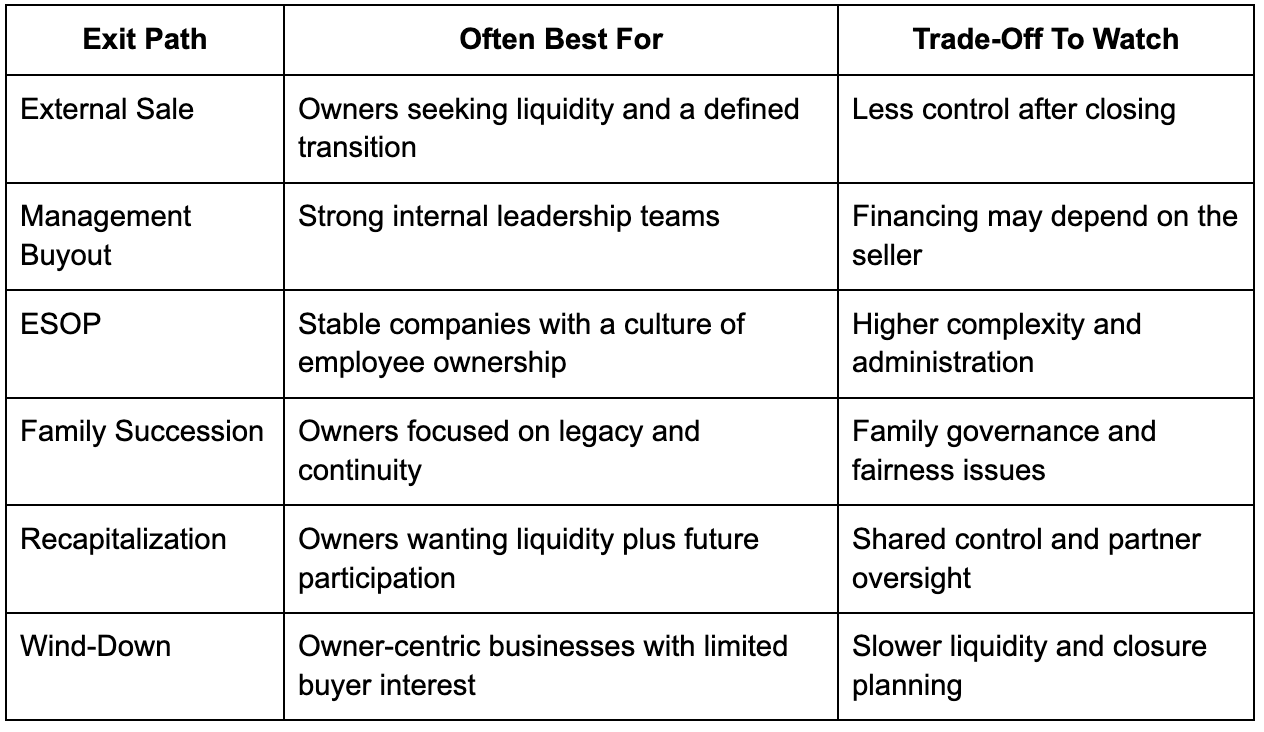
The useful question is not which option sounds best in isolation. It is which one fits your cash needs, energy level, family situation, and tolerance for post-closing obligations.
Prepare The Business So Value Is Easier To See
A buyer or successor pays for transferable cash flow. That means the business needs to show that revenue, margins, relationships, and operations can continue without the owner standing in the center of every decision.
Preparation often starts 18 to 36 months before an intended transition. That window gives you time to clean up financials, strengthen leadership, reduce concentration risks, and address issues that can slow diligence.
Focus first on the areas that shape buyer confidence:
Reviewed or audited financial statements with defensible adjustments
Clear working-capital trends and documented revenue drivers
Written operating procedures for core functions
A leadership team that can make decisions without daily owner involvement
Customer and supplier contracts with assignable terms where possible
Confirmed intellectual property ownership and licensing rights
Current insurance, HR, cybersecurity, privacy, tax, and legal records
Financial clarity deserves special attention. Normalized earnings should be credible, not aspirational. Add-backs need support. Forecasts should tie to capacity, pipeline, pricing, retention, and actual operating data.
Owner dependence can be just as important. If customer relationships, pricing decisions, hiring, vendor negotiations, and technical knowledge all run through one person, a buyer may reduce value or insist on a longer transition. Cross-training, documented authority, durable contracts, and a visible second layer of leadership can help reduce that concern.
If you are beginning to evaluate your exit timeline, it can help to contact the office before deal discussions become active. Coordinating your business readiness work with your personal financial plan can make the next set of decisions more disciplined and less driven by whichever buyer or successor appears first.
Consider Elements Beyond The Headline Price
The purchase price gets the attention. The structure determines how much flexibility you may actually receive.
Most private-company exits include trade-offs. Cash at close may be only part of the consideration. Seller notes, earn-outs, escrows, holdbacks, rollover equity, employment agreements, consulting periods, and non-compete terms can all affect your financial outcome and your day-to-day life after closing.
That is why deal planning should happen before the letter of intent. Once exclusivity begins, leverage can narrow. Key terms to review with your financial, legal, and tax professionals include working-capital targets, escrow amounts, indemnification terms, earn-out formulas, decision rights after closing, and the expected length of your transition role.
Taxes also need early attention. Entity structure, asset sale versus stock sale treatment, installment payments, state tax exposure, and pre-transaction cleanup can all change the after-tax result. The goal is not to chase a tax outcome in isolation. The goal is to understand what the transaction may mean for retirement income, liquidity, risk, and timing.
Turn Business Sale Proceeds Into A Personal Financial Plan
A successful exit does not end with the closing wire. For many owners, the harder adjustment comes next: moving from a concentrated business asset to a portfolio designed to support spending, taxes, family goals, and future uncertainty.
Start by defining “enough” in after-tax terms. What income will you need from the sale proceeds? How much should remain liquid? What bridge years need funding before Social Security, Medicare, pensions, or required minimum distributions become relevant? How would the plan hold up under inflation, market volatility, health care costs, or a delayed sale?
The personal side deserves the same seriousness as the transaction. Many owners are used to being needed daily. After the exit, that structure changes. Board service, mentoring, philanthropy, consulting, travel, family time, or a new venture can all provide direction, but they should be chosen deliberately rather than used to fill a sudden void.
Family planning may also become more visible after liquidity arrives. Beneficiary designations, trusts, estate documents, charitable intentions, and expectations among heirs should be reviewed while decisions are still calm. If some family members work in the business and others do not, fairness and control should be addressed separately.
Sequencing Your Business Exit
Exit planning has a cadence, even when the timeline changes.
In the first six months, clarify personal goals, estimate retirement income needs, identify likely exit paths, and assemble your advisory team. This is also the time to begin assessing business readiness.
Over the next six to eighteen months, strengthen financial records, document processes, update contracts, evaluate leadership gaps, and reduce concentration risks. Owners considering an ESOP, management buyout, or family succession may also begin feasibility work and financing conversations.
From eighteen to thirty-six months, the business and personal plan should start moving together. A sale process, internal transition, recapitalization, or succession plan can proceed with fewer surprises when the financial, tax, legal, and operational pieces have already been addressed.
The exact dates matter less than the order. Personal planning should not wait until after the deal, and business cleanup should not begin after diligence requests arrive.
Frequently Asked Questions About Exit Strategies For Owners Nearing Retirement
These questions come up often when owners begin connecting retirement planning with business transition planning. The answers depend on the company, the family, the market, and the owner’s personal financial picture.
How Early Should I Start Planning My Exit?
Many owners benefit from starting 18 to 36 months before they want a transition. A longer runway gives you time to improve financial reporting, reduce owner dependence, strengthen leadership, and evaluate tax-aware planning steps.
Should I Choose The Buyer Offering The Highest Price?
Not automatically. Deal structure, taxes, seller financing, earn-outs, rollover equity, and required transition work can all change the practical value of an offer. The better comparison is after-tax, risk-adjusted liquidity and how well the terms fit your life after closing.
Is An ESOP Only For Large Companies?
No, but an ESOP requires stable cash flow, committed leadership, independent valuation, and ongoing administration. A feasibility study can help determine whether the structure fits the company and the owner’s objectives.
What If My Children Disagree About The Business?
Document roles, ownership rights, compensation, voting power, and buy-sell terms before a transition occurs. When some heirs work in the business and others do not, separating economic benefit from control may help reduce conflict.
What Happens If A Deal Falls Apart?
A failed deal does not have to derail retirement planning if alternatives remain viable. Maintaining business momentum, preserving confidentiality, and keeping other paths open, such as a management buyout, recapitalization, or later sale process, can protect flexibility.
Plan The Exit Before The Exit Plans You
An exit strategy for a retiring business owner should connect three things: a company that can transfer value, deal terms that support usable liquidity, and a personal plan for income, taxes, family, and life after ownership. The best path may be a sale, management buyout, ESOP, family succession, recapitalization, or wind-down, but the strongest outcomes usually come from preparation rather than pressure. Start early, compare options with care, and do the math before the decision window narr