


Losing a spouse brings emotional weight that no amount of preparation can soften, and it often arrives alongside a stack of paperwork and decisions that feel poorly timed. The Social Security surviving spouse benefit is one piece of that paperwork, but it can also be a meaningful source of financial stability during a difficult transition. This guide walks through who qualifies, how the benefit is calculated, when it may make sense to claim, and how it fits alongside the rest of your retirement income and tax plan.
Key Takeaways
Eligibility for the Social Security surviving spouse benefit often begins at age 60, earlier if you are disabled or caring for a child, and it depends on your spouse's work record.
Your benefit amount is anchored to your spouse's Primary Insurance Amount (PIA), which reflects whether they filed early or delayed their own benefit.
You generally receive the higher of your own benefit or the surviving spouse benefit, not both in full, though some retirees start with one and switch to the other later.
Working before your survivor full retirement age (FRA) can temporarily reduce payments, and taxes are a separate consideration from the earnings test.
Coordinating this benefit with withdrawals, Roth conversions, and RMDs may help manage your long-term tax picture.
What Are Social Security Surviving Spouse Benefits, and Who Qualifies?
The Social Security surviving spouse benefit is a monthly payment based on your deceased spouse's earnings record. If your spouse earned enough Social Security credits during their working years, you may be eligible for a payment that reflects what they were receiving, or were entitled to receive, at the time of death.
Eligibility by age and status. Many widows and widowers can claim starting at age 60, or as early as 50 if disabled. If you are caring for the deceased worker's child who is under 16 or disabled, you may qualify at any age. Survivor rules differ from standard spousal benefit rules, which opens the door to some coordination strategies with your own retirement benefit.
Surviving divorced spouse rules. If your marriage to the deceased worker lasted at least 10 years and other requirements are met, you may still qualify as a surviving divorced spouse. Current marital status and the timing of any remarriage also factor into eligibility, which we cover in the special situations section below.
How Is the Surviving Spouse Benefit Calculated?
Your payment is built around your spouse's PIA, the figure that reflects a lifetime of indexed earnings. If your spouse claimed their own benefit early, the base used to calculate your survivor benefit may be lower if they delayed past their full retirement age and earned delayed retirement credits; those credits typically carry over and can increase your payment.
A rule known as the widow's (er) limit keeps the survivor amount within a defined range of the worker's PIA, and annual cost-of-living adjustments generally apply to survivor payments as well, which helps preserve purchasing power over time.
When Should You Claim? Timing and Strategy Considerations
You can begin the surviving spouse benefit as early as age 60, but claiming before your survivor's full retirement age reduces the monthly amount. It's worth noting that your survivor's FRA may differ from the FRA that applies to your own retirement benefit, so both should be confirmed before you decide.
Unlike your own retirement benefit, waiting past survivor FRA typically does not increase the surviving spouse benefit further, since the amount already reflects any delayed credits your spouse earned. The more useful question tends to be how claiming age balances your current cash-flow needs against the sustainability of your income over the long run.
Before filing, it can help to compare a few different scenarios that account for your other income sources and taxes side by side. This is a case where a short planning conversation can go a long way toward aligning your claiming decision with your broader cash-flow, Medicare, and portfolio plans.
How Does This Coordinate With Your Own Social Security Benefit?
You cannot receive your own Social Security retirement benefit and a full surviving spouse benefit at the same time. Instead, Social Security pays a single combined amount equal to the higher of the two, sometimes structured as your own benefit plus a survivor "top-up."
Some retirees choose to begin with the surviving spouse benefit and switch to their own retirement benefit later, if the amount available at age 70 will be larger. This flexibility is unique to survivor benefits and can be a useful lever for maximizing lifetime income. If your own benefit already exceeds the surviving spouse amount, relying on your own record may be the more straightforward path. However, it's still worth checking whether a brief overlap offers any advantage in your specific situation.
This benefit also interacts with the rest of your income plan. Coordinating it with Roth conversions, pension elections, annuity payouts, and RMD timing can influence your lifetime tax picture and help smooth out cash flow year to year.
What Special Situations Should You Know About?
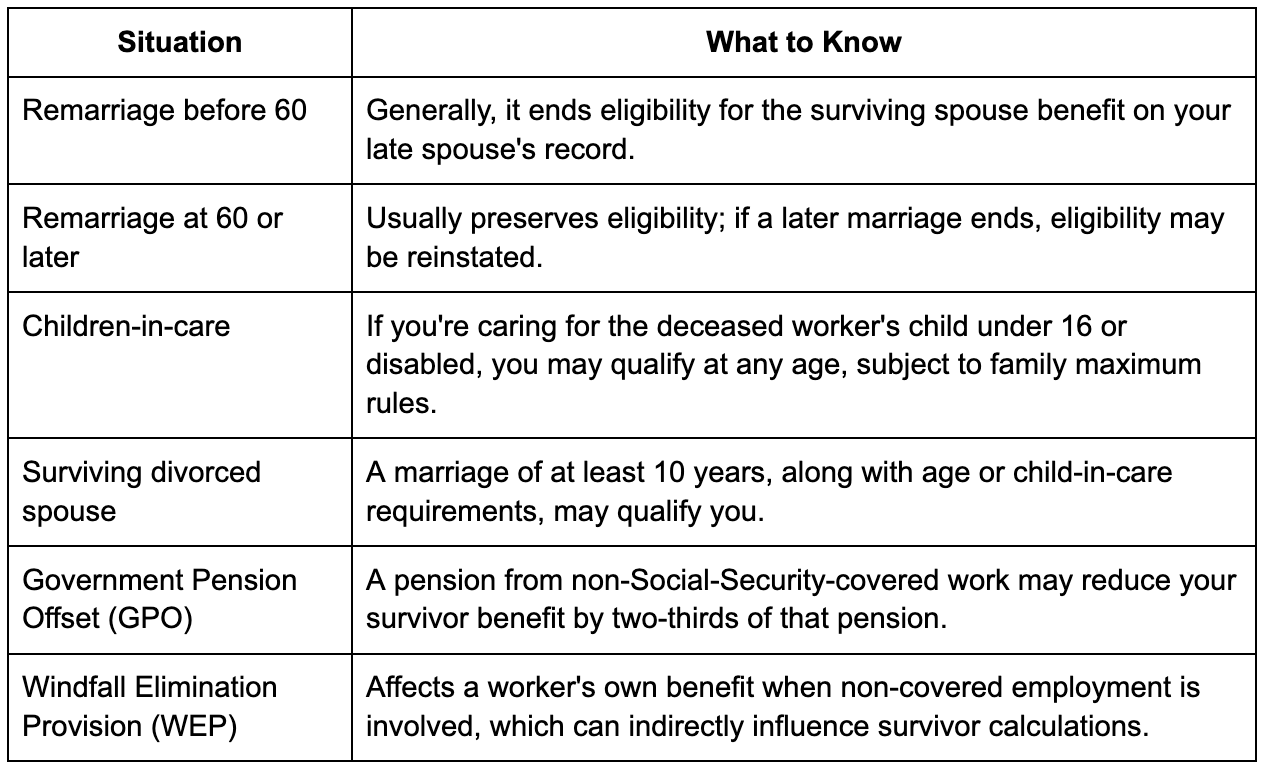
Because these rules intersect in different ways depending on your history, it's worth confirming your specific estimates before making any pension or claiming decisions.
How Do Work and Taxes Factor In?
The earnings test. If you claim before your survivor FRA and continue working, earnings above the annual limit may temporarily reduce your monthly payment. Withheld amounts aren't entirely lost; they're partially credited back once you reach FRA, though the interim reduction in cash flow is worth planning for.
Taxation. Taxes are a separate matter from the earnings test. Depending on your combined income, up to 85% of Social Security benefits can be taxable, and RMDs can push more of that benefit into the taxable range as adjusted gross income rises. Pairing this benefit with tax-aware withdrawal sequencing may help manage the impact over time.
What Should You Gather Before Filing?
A bit of organization up front can ease the process and make any planning conversation more productive.
Documents: Death certificate, marriage certificate, Social Security numbers, award letters, and recent account statements.
Numbers: An official Social Security survivor benefit estimate, along with a log of any calls, dates, and agent names.
Income picture: A list of other income sources, such as IRAs, pensions, annuities, and brokerage accounts, alongside your monthly cash-flow needs.
Key dates: Your survivor FRA, Medicare open enrollment windows, and any upcoming RMD milestones.
Special rules: Remarriage timing, children-in-care status, and any non-covered pension that could trigger GPO.
Frequently Asked Questions About Surviving Spouse Benefits
Can I receive my own Social Security benefit and a surviving spouse benefit at the same time? You may qualify for both, but you generally receive the higher of the two rather than both in full. Some retirees begin with the surviving spouse benefit and switch later.
Does waiting past survivor FRA increase the benefit? Typically not. If your late spouse earned delayed credits, those amounts are usually already built into the calculation.
Will remarriage end my surviving spouse benefits? Remarriage before age 60 generally ends eligibility on that record, while remarriage at 60 or later usually preserves it.
How does working affect this benefit? Earnings above the annual limit before your survivor FRA can temporarily reduce payments, though adjustments at FRA may account for some of the reduction.
Are surviving spouse benefits taxable? Depending on your total income, up to 85% of Social Security benefits can be taxable. Coordinating withdrawal sequencing may help manage this.
How do GPO and WEP factor in? GPO may reduce your surviving spouse benefit if you receive a non-covered pension. WEP affects a worker's own benefit and can indirectly influence survivor calculations.
Can a surviving divorced spouse qualify? Yes, if the marriage lasted at least 10 years and other criteria are met.
Can I switch from the surviving spouse benefit to my own later? Often, yes, particularly if your benefit at age 70 will be higher than the survivor amount.
Planning Your Next Step
The Social Security surviving spouse benefit can be a stabilizing piece of your retirement income when it's coordinated thoughtfully with the rest of your plan. Eligibility, how the amount is calculated, and when you claim all shape the outcome, and special situations like remarriage, GPO, WEP, or working before survivor FRA can shift the picture further.
We think of ourselves as your financial advocate, often the third call when things change, right after family and faith. If you're weighing this decision, contact Rinvelt & David. We can help you do the math and see how the surviving spouse benefit may fit alongside your income, taxes, and Medicare timeline.
The content is developed from sources believed to be providing accurate information. The information in this material is not intended as tax or legal advice. Please consult legal or tax professionals for specific information regarding your individual situation. Some of this material was developed and produced by FMG Suite to provide information on a topic that may be of interest. FMG Suite is not affiliated with the named representative, broker-dealer, state- or SEC-registered investment advisory firm. The opinions expressed and material provided are for general information, and should not be considered a solicitation for the purchase or sale of any security.
Securities offered through Kestra Investment Services, LLC (Kestra IS), member FINRA/SIPC. Investment advisory services offered through Kestra Advisory Services, LLC (Kestra AS), an affiliate of Kestra IS. Rinvelt & David, Bluespring Wealth Partners, LLC, Kestra IS and Kestra AS are affiliated through common ownership by Kestra Holdings. Kestra IS and Kestra AS do not provide tax or legal advice.